APR vs Simple Interest: How to Compare Business Loan Interest Rates
When business owners start exploring funding options, one of the first questions that usually comes up is: “What’s the interest rate?”
But when comparing business loans, the headline rate doesn’t always tell the full story. At Bizzy, we see business owners compare loan offers every day - and the headline rate is consistently the most misunderstood part of any quote.
Lenders present rates in different ways. Some use simple interest rates, others quote a monthly rate, while some use an Annual Percentage Rate (APR). Because these rates are calculated differently, a loan that appears cheaper at first glance may actually cost more over time.
In other words, two loans with similar sounding rates, terms and loan amounts can end up costing very different amounts over the life of the loan.
Understanding how these rates work can help you make a more informed decision when comparing business funding options, and could save your business thousands of dollars of the life of a loan.
What is a Simple Interest Rate?
What is an Annual Percentage Rate (APR)?
Simple Interest vs APR: What’s the Difference for Business Loans?
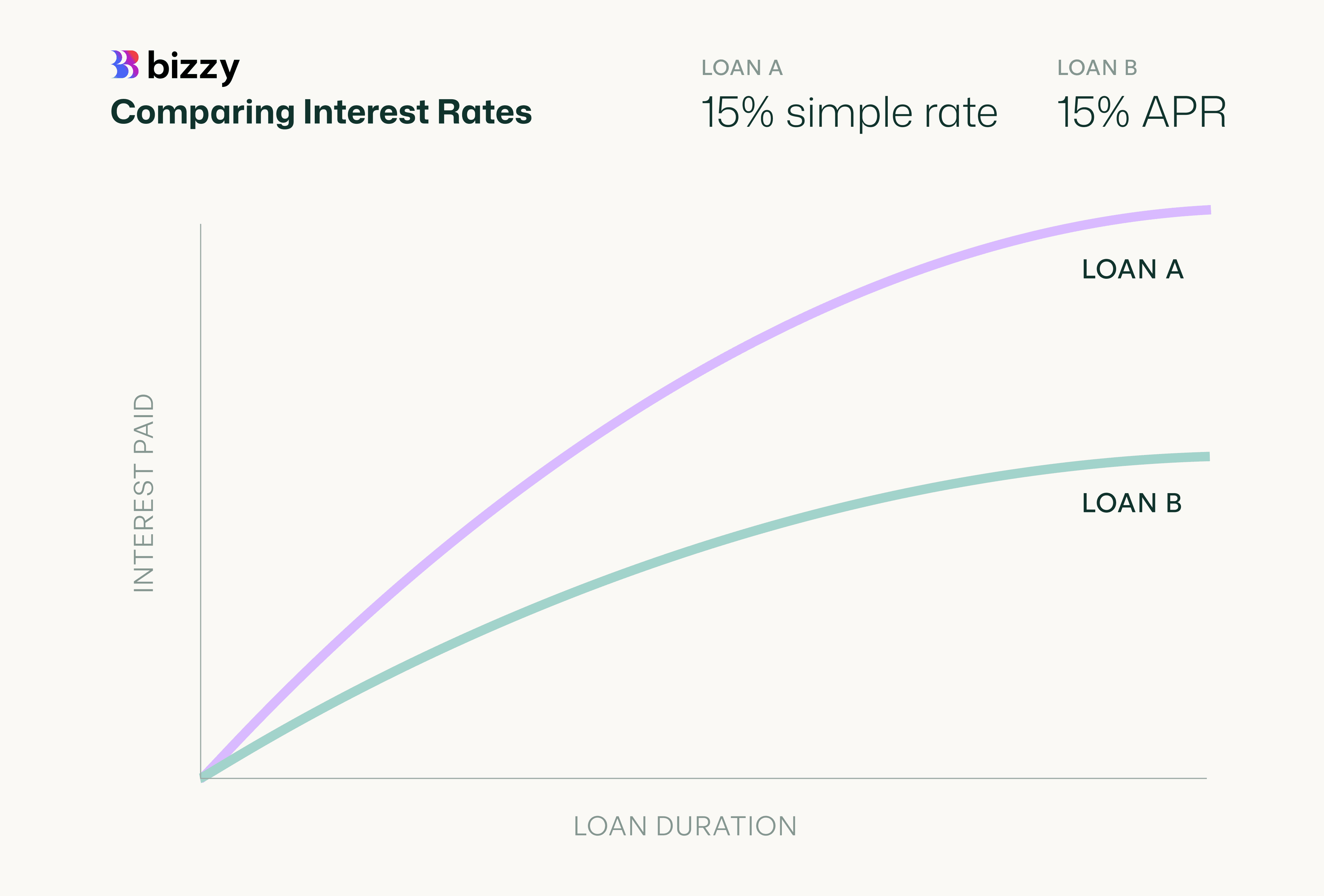
The key difference is how the interest is calculated. A simple interest rate is calculated on the full original loan amount for the entire loan term, regardless of how much of the loan has already been repaid.
An Annual Percentage Rate takes into account the declining loan balance, meaning interest is calculated on the remaining principal after each payment over the full loan term.
Because the loan balance decreases over time as you repay principal, loans with an APR typically result in lower total interest costs than a simple interest rate, even when both loans advertise the same headline percentage rate.
Let’s look at an example of comparing a 12% simple rate vs a 12% APR:
Loan Amount
$20,000
$20,000
Loan Term
24 months
24 months
Annual Percentage Rate (APR)
~21-22%
12%
Difference in Interest
Estimated $2,204.71 more in interest
Because APR includes more of the total loan cost, the rate often appears higher than a simple interest rate, even if the loan may actually cost less overall.
How do I calculate an APR from a Simple Rate to compare?
To calculate an APR from a simple rate, you first work out the total repayments, then solve for the interest rate that reflects how the loan is actually repaid over time. Luckily, we created a calculator linked below you can use to do this. But if you’re interested in how it works behind the scenes, here is the formula to calculate an APR from a Simple Rate:
Calculate the interest: Loan Amount x Simple Rate (as decimal) x Term (in years)
Calculate the total repayment amount : Interest + Principal
Monthly Payments = Total Repayment / Number of repayments
Solve for the period rate (in this case the monthly rate) = RATE(number of repayments, -monthly payment, loan amount)
APR = Period Rate x Number of periods in a year
Taking the example as above for a $20,000 loan, with a simple rate of 12% for 2 years
Interest = 20,000 x 0.12 x 2 = 4,800
Total Repayments = 20,000 + 4,800 = 24,800
Monthly Payments = 24,800/24 = 1,033.33
Monthly Rate = RATE(24, -1,033.333333, 20000) ~1.8%
APR = 1.8% x 12 = ~21.6%
Example: Comparing Two Business Loans
Imagine you receive two business loan offers through Bizzy, both for $50,000 over a 36-month term.
Loan A has an 15% simple interest rate
Loan B has an 18% annual percentage rate (APR)
At first glance, Loan A looks cheaper because the headline rate is lower, but once you calculate the total cost of borrowing the picture changes.
Here is an example of comparing a 15% simple rate vs a 18% APR quote:
Loan Amount
$50,000
$50,000
Loan Term
36 months
36 months
Annual Percentage Rate (APR)
~25-26%
18%
Difference in Interest
Estimated $7,425 more in interest
While the headline number hasn’t changed, when you break down the interest over the loan, the total cost of borrowing has.
This is one of the most common areas of confusion when comparing business lending options.
Download our Bizzy Interest Spreadsheet to help you calculate and compare APR vs Simple Interest Rate Quotes.
Beyond the Interest Rate: What else to consider
When reviewing loan offers, the interest rate may be the first thing you look at, but it’s not the only important factor. Here are the three key things business owners should consider when comparing loans:
The total cost of borrowing: This often provides the clearest comparison between offers. It includes the dollar value of all interest charged over the life of the loan, as well as any upfront or ongoing fees such as establishment fees, broker fees, administrative costs, or early repayment charges. Note that a longer repayment term may result in a higher total cost of borrowing, but could still be the most suitable option for managing cashflow.
Annual Percentage Rate: It's difficult to compare loans when some show a monthly rate, a daily rate, or a simple annual rate calculated differently. Converting these into a single standardised figure - the Annual Percentage Rate - makes it easier to compare like for like.
Repayment terms and flexibility: Review the repayment frequency, how interest is calculated and other loan features, including whether the loan allows extra repayments, early repayment without penalties, or redraw options.
In our experience working with a lot of business owners and a wide range of lenders, looking at the total amount repaid over the life of the loan is often the simplest way to compare options. That’s why Bizzy asks lending partners to provide quotes with a total cost of the loan, which makes it easier for businesses to compare multiple lending offers side by side.
The headline interest rate is only part of the picture
When comparing business loans, the advertised interest rate doesn’t always reflect the true cost of borrowing.
Understanding whether a loan uses a simple interest rate or an annual percentage rate can make a significant difference to the total interest paid over the loan term and is important to consider when evaluating offers.
A small difference in how the rate is presented can result in thousands of dollars in additional repayments over the life of the loan.
Taking the time to compare the total cost of the loan, not just the advertised rate, can help ensure you choose the option that best fits your business needs.
Thinking about funding options for your business?
Bizzy lets businesses explore and compare lending offers from multiple lenders with a single application - helping you see the rates, fees, and overall costs in one place.